55 Business Casual Women: Complete Guide to Modern Office Style
Here’s the truth: business casual women isn’t one specific outfit. It’s a range. It’s the sweet spot between “I’m attending a black-tie gala” and “I’m running errands on Saturday.” It’s polished without being stiff. Put-together without being overdressed. And in 2026, it looks better and feels more comfortable than ever before.
This guide covers everything you need to know. From women’s workwear basics to seasonal outfit ideas, capsule wardrobe building, and the mistakes most women make without realizing. Whether you’re starting a new job, refreshing your closet, or just tired of the daily “what do I wear?” panic you’re in the right place. Let’s get into it.
What Is Business Casual for Women?
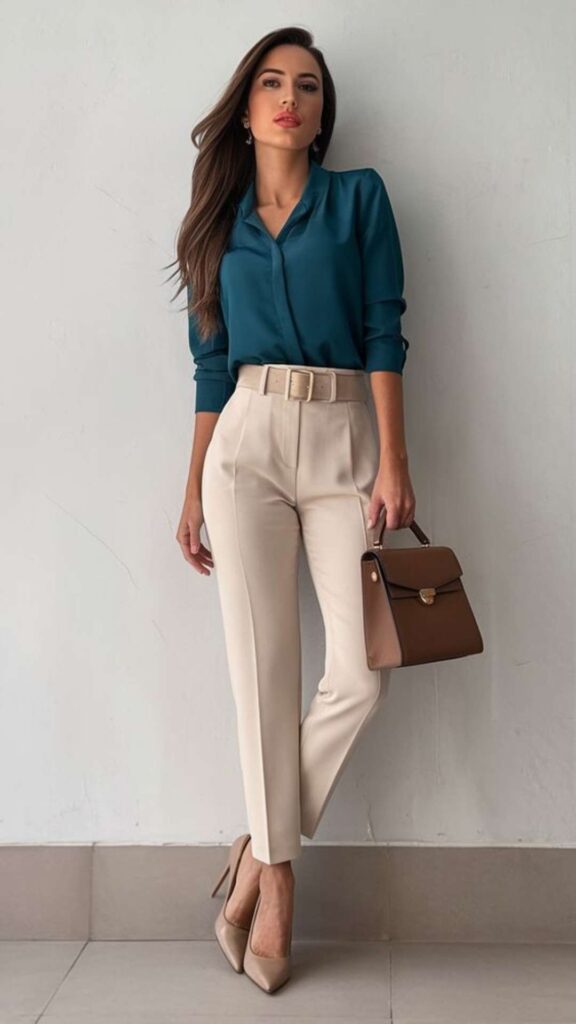
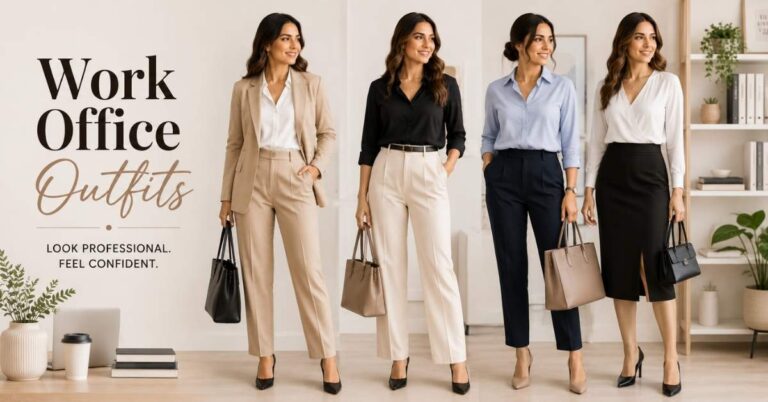
Business casual for women is a dress code that sits between formal business attire and everyday casual clothing. It means looking professional and put-together without wearing a full suit or formal gown. Think tailored trousers, clean blouses, blazers, midi dresses, and polished shoes. It’s the uniform of the modern American workplace and it’s more flexible than most people realize.
The term first gained popularity in the 1990s when tech companies began loosening their dress codes. Before that, offices ran on strict business professional clothing suits, ties, pencil skirts, and structured jackets. Then Silicon Valley started showing up in khakis and polo shirts, and the rest of corporate America slowly followed. Fast forward to 2026, and business casual outfits for women now include everything from wide-leg trousers to clean white sneakers, depending on your industry and company culture.
What makes business casual tricky is that it means different things in different workplaces. A business casual outfit at a law firm in New York looks very different from business casual at a creative agency in Austin. The core principle stays the same though your clothing should communicate competence, respect for the environment, and a level of personal care. It should never distract or feel sloppy. If you walk into a room and your outfit immediately reads as “professional,” you’ve nailed it.
What Does Business Casual Look Like Today?
In 2026, modern office outfits for women lean heavily toward comfort and intention. The pandemic permanently shifted how Americans think about workwear. Remote work normalized softer fabrics and relaxed silhouettes. When offices reopened, workers didn’t want to go back to rigid, uncomfortable clothing and most companies adapted. Today’s work fashion for women blends structure with ease in a way that feels genuinely wearable.
Practically speaking, today’s business casual women’s outfits might include a linen blazer over a fitted knit top with wide-leg trousers and loafers. Or a wrap dress with a structured cardigan and pointed-toe flats. Or dark-wash straight jeans with a silk blouse and block-heel mules. The emphasis is on fit, fabric quality, and intention. Clothes don’t need to be stiff to look professional. They just need to look deliberate.
| Old Business Casual (Pre-2020) | Modern Business Casual (2026) |
| Stiff blazer with khaki pants | Relaxed blazer with wide-leg trousers |
| Closed-toe pumps only | Loafers, block heels, clean leather sneakers |
| Collared button-down shirts | Silk blouses, fitted knits, tucked turtlenecks |
| Muted neutrals only | Soft colors, subtle prints, texture mixing |
| Polyester mix fabrics | Linen, ponte, crepe, wool-blend |
| Tight pencil skirts | Midi skirts, A-line, relaxed cuts |
The shift toward polished office style women appreciate is real and it’s intentional. Designers have responded. Brands like Banana Republic, M.M. LaFleur, Everlane, and Ann Taylor have completely overhauled their workwear collection women love — prioritizing fabrics that breathe, cuts that move, and styles that work both in the conference room and at dinner afterward.
Business Casual vs Smart Casual vs Business Professional
These three dress codes confuse almost everyone. Here’s a simple breakdown so you never mix them up again.
Business professional is the most formal. It means a full suit or a structured blazer with matching trousers or a skirt, formal blouses, and closed-toe heels. You’ll wear this to court, formal board presentations, or high-stakes client meetings.
Business casual sits in the middle. It’s polished and intentional but not rigidly formal. Blazers work here, but so do structured dresses and tailored separates without matching pieces. This is the daily uniform for most American office workers.
Smart casual is more relaxed than business casual. It’s what you’d wear to a nice dinner or a casual Friday at a creative office. Clean jeans, stylish tops, fashion-forward pieces all appropriate. It’s not quite office-ready for most corporate environments but it’s definitely not loungewear either.
| Dress Code | Key Pieces | Typical Setting |
| Business Professional | Full suit, formal blouse, structured heels | Law firms, finance, formal meetings |
| Business Casual | Blazer, trousers, dress, loafers | Most US office environments |
| Smart Casual | Dark jeans, stylish tops, clean sneakers | Creative offices, casual Fridays |
Industries Where Business Casual Is Common
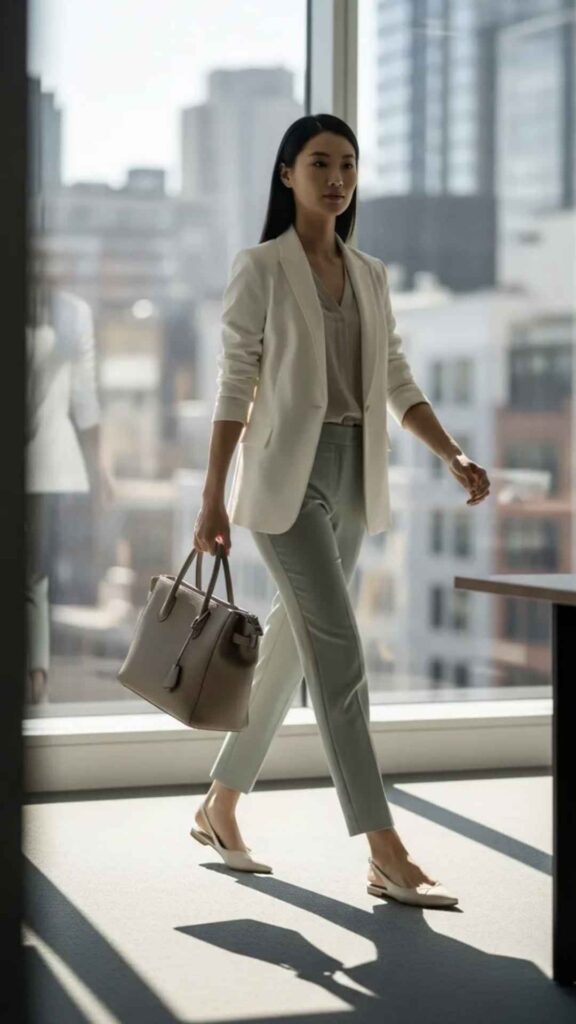
Business casual isn’t universal across every sector but it dominates a wide range of American industries. Understanding where it applies helps you calibrate exactly how dressed-up or relaxed your interpretation should be.
Finance and banking lean toward the conservative end of business casual. You’ll see more structured blazers, neutral color palettes, and formal-adjacent pieces. Marketing, PR, and media agencies embrace a more expressive version color, print, and personality are welcome. Tech companies and startups often operate at the relaxed end of the spectrum, where dark jeans and a neat blazer genuinely qualify. Healthcare administration, real estate, education, and consulting all sit firmly in classic business casual territory structured but not severe.
| Industry | Business Casual Interpretation | Key Pieces |
| Finance & Banking | Conservative, structured | Blazer, tailored trousers, neutral tones |
| Marketing & Media | Expressive, fashion-forward | Prints, color, personality-driven pieces |
| Tech & Startups | Relaxed, minimal | Clean jeans, smart basics, loafers |
| Healthcare Admin | Neat and practical | Ponte pants, blouses, comfortable flats |
| Real Estate | Polished and approachable | Wrap dresses, blazers, block heels |
| Education | Comfortable and professional | Cardigans, midi skirts, flat shoes |
The key insight here? What to wear to office for women depends enormously on your specific industry. Always observe what senior women at your company wear. Their choices reflect the unwritten dress code better than any employee handbook ever will.
Business Casual Wardrobe Essentials for Women
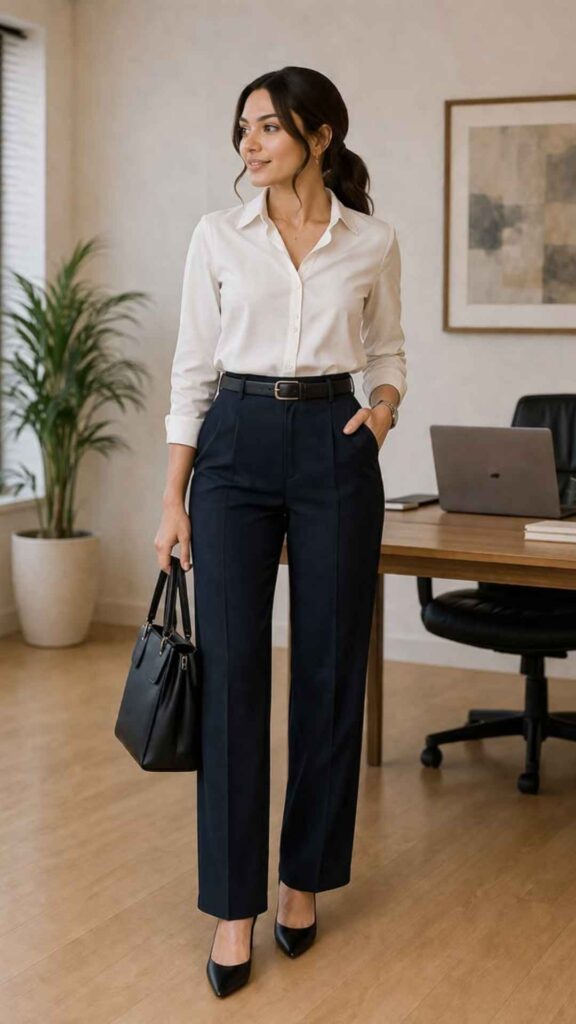
Building a strong work wardrobe essentials women can rely on starts with understanding which pieces carry the most weight. You don’t need a closet bursting with clothes. You need the right clothes pieces that mix well, hold their shape, and make you feel like the most competent version of yourself the moment you put them on. The goal is a professional wardrobe for women that works hard without requiring daily creativity.
What is business casual for women when it comes to building a wardrobe? It’s a curated collection of versatile pieces in quality fabrics. Invest in fit before anything else. A $60 blazer that fits perfectly looks better than a $300 blazer that doesn’t. Every essential piece below serves multiple outfit combinations that’s the whole point of dressing with intention.
Blazers and Jackets
The blazer is the single most powerful piece in any women’s work clothing collection. Full stop. It transforms almost any outfit from casual to professional in under three seconds. Throw one over a plain T-shirt and suddenly you’re ready for a meeting. Layer it over a dress and you’ve got a polished head-to-toe look with zero effort. The blazer is your best friend in the office.
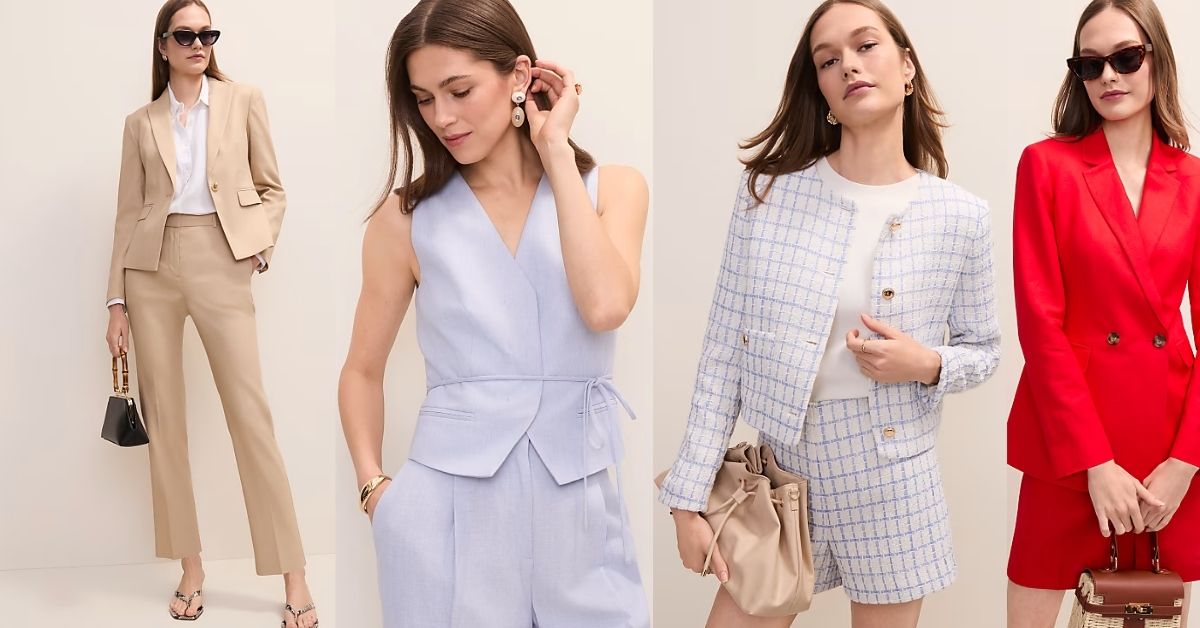
In 2026, tailored office wear women gravitate toward includes the classic structured blazer in black, navy, or camel but also the relaxed, slightly oversized blazer in linen or soft suiting fabric. Cropped blazers work well with high-waisted trousers. Longline blazers create a sleek, elongating silhouette over slim pants. The ponte blazer is particularly practical it holds its shape without needing dry cleaning and looks crisp all day even during long hours. When shopping for blazers, try them in at least two or three neutral colors. Those pieces alone will build the backbone of your entire office dress code outfits rotation.
Business Casual Tops and Blouses
The right top can anchor an entire outfit. Professional attire for women in 2026 leans heavily on silk and satin blouses they read instantly as elevated, they photograph beautifully for video calls, and they layer effortlessly under blazers. A classic ivory silk blouse is arguably as important as the blazer itself. Button-down shirts in crisp cotton or chambray offer a more structured, slightly masculine-inspired look that never goes out of style.
Beyond blouses, fitted crewneck knits and turtlenecks have earned serious real estate in chic work outfits women wear daily. They’re comfortable for long days, look polished on camera, and work across all four seasons with the right layering. The key with tops is fabric and fit. Anything sheer, overly revealing, or in a stretched-out fabric undermines an otherwise professional outfit. When in doubt, tuck your top even a partial tuck signals intentionality and sharpens your silhouette considerably.
Tailored Pants and Trousers
If blazers are the king of corporate clothing women rely on, tailored trousers are the queen. Nothing communicates professionalism more clearly than a well-fitted pair of trousers. And in 2026, “well-fitted” doesn’t mean skin-tight or uncomfortably structured. Wide-leg trousers have completely taken over the American office they’re comfortable enough for all-day wear but look just as sharp as any traditional slim-cut pant.
How to dress professionally but comfortably is a question every working woman asks and the answer usually starts with trousers. Straight-cut, ankle-length, or wide-leg all work beautifully in business casual environments. The most versatile colors are black, navy, camel, charcoal, and cream. These neutrals pair with almost every top in your closet. One practical tip: invest in two to three pairs of well-made trousers before buying anything else. They form the literal foundation of your work wardrobe essentials women need to get dressed confidently every single morning.
Skirts for Business Casual Offices
Skirts deserve more credit than they get in modern workwear conversations. The midi skirt in particular has become a cornerstone of office appropriate outfits women love because it’s feminine without being fussy, comfortable without being casual. A structured midi skirt in a solid color or subtle pattern pairs with almost any tucked blouse or fitted knit for a complete, polished look.
Pencil skirts remain a classic choice for more conservative environments they’re sleek, professional, and work especially well for presentations or client-facing roles. A-line skirts offer more ease of movement and suit a broader range of body types. Whatever style you choose, keep the hemline at or below the knee for most professional settings. Fabric matters enormously here. A structured ponte or wool-blend skirt will always look more professional than a flimsy chiffon option in the same silhouette.
Business Casual Dresses
For the ultimate in simple work outfits for everyday office wear, nothing beats a well-chosen dress. It’s one piece, it’s complete, and it requires almost no styling effort. The wrap dress is a perennial favorite it’s universally flattering, easy to wear, and looks effortlessly put-together. Sheath dresses offer a more structured, corporate-leaning look that works beautifully in conservative environments. Shirt dresses split the difference relaxed in feel but smart in appearance.
Elegant office outfits for presentations often center around a great dress. Pair a structured sheath with pointed-toe heels and minimal jewelry and you’re completely presentation-ready. Add a blazer over a wrap dress and you’ve got one of the most versatile office outfits for women that genuinely goes from your 9 a.m. strategy meeting to a 7 p.m. work dinner without missing a beat. When shopping for work dresses, prioritize fabric weight heavier fabrics like ponte, crepe, and structured jersey hold their shape and look professional all day long.
Professional Shoes for Business Casual
Your shoes communicate more than you think. They’re often the first thing people notice after your face. Work fashion for women in 2026 has broadly agreed on one winner: the loafer. Classic leather loafers in black, tan, or burgundy are simultaneously comfortable, stylish, and completely appropriate across virtually every professional environment. They pair with trousers, skirts, and dresses equally well.
Block heels are another fantastic option. They provide height without the discomfort of a stiletto important when you’re on your feet for long hours or navigating an office building all day. Pointed-toe flats offer sleekness and sophistication without any heel at all. As for sneakers clean, minimalist leather sneakers have officially crossed into business casual territory in many workplaces, particularly in tech and creative industries. What you should avoid: worn-out sneakers, flip-flops, heavily embellished shoes, or anything that looks like it belongs at a beach. Your shoes should look as intentional as the rest of your outfit.
Accessories That Elevate Your Look
Accessories are where women office fashion gets genuinely interesting. The right accessories don’t just complete an outfit they signal taste, intentionality, and personality within professional boundaries. The key word is restraint. One or two well-chosen pieces always beat a collection of competing accessories.
A structured leather tote or work bag is arguably your most visible professional accessory. It’s the first thing colleagues and clients see when you walk into a room. Invest in a quality bag in a neutral color black, cognac, or navy and it will anchor every outfit in your wardrobe for years. Simple gold or silver jewelry adds polish without distraction. A classic watch signals professionalism and respect for time in a way no other accessory can. Scarves, belts, and subtle hair accessories can inject personal style without compromising your professional image.
Read More About: best Cute Outfits for Women: 25 Stylish Outfit Ideas for Every Occasion
Business Casual Outfit Ideas for Women
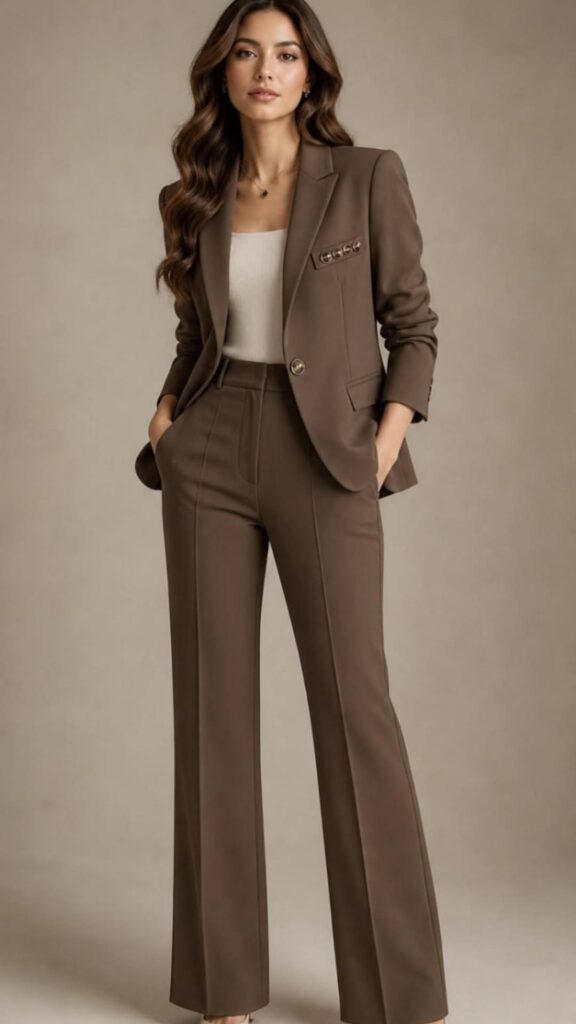
Sometimes you just need someone to tell you exactly what to wear. Best outfits for business casual office environments don’t have to be complicated or expensive. The combinations below work across industries, seasons, and body types and every single one of them can be built from the wardrobe essentials already discussed.
Outfit ideas for working women professional style often come down to formula: one structured piece plus one relaxed piece, tied together with the right shoe. That simple equation produces more outfit combinations than most women realize and it’s the secret behind every capsule wardrobe for office wear women should build.
Silk Blouse and Ankle Pants
This is the quintessential business casual outfit for women timeless, universally flattering, and endlessly versatile. A silk or satin blouse in ivory, blush, or a soft print tucked into ankle-length tailored trousers creates an immediately polished look. The contrast between the fluid blouse and the structured pant is what makes this combination work so well visually.
For footwear, pointed-toe flats or block-heeled mules complete the look without competing with it. Add a structured handbag in a complementary neutral and a single piece of simple jewelry a delicate necklace or small gold earrings and you’re completely dressed for anything from a Monday morning meeting to a Friday client presentation. This outfit also adapts beautifully across seasons: swap the blouse for a cashmere knit in winter or choose a linen ankle pant in summer.
Button-Down Shirt and Wide-Leg Trousers
How to style work outfits for women who want a clean, modern look without overthinking it? Start here. A crisp cotton or chambray button-down tucked into wide-leg trousers is one of the most satisfying combinations in contemporary women’s workwear. It’s structured enough for corporate environments and relaxed enough for creative offices.
The styling detail that makes this outfit feel current rather than dated is the half-tuck pulling just the front of your shirt into your waistband creates a casual intentionality that looks very 2026. Add loafers and a minimal tote and you’ve nailed the modern office look completely. Play with proportions here: a slightly oversized button-down with a high-waisted wide-leg trouser creates a chic, fashion-forward silhouette that photographs beautifully for virtual meetings.
Blazer with Dark Jeans
Yes jeans can absolutely be business casual. With the right execution. Dark-wash, straight-cut or slim-fit jeans with no distressing, no fading, and no rips are perfectly appropriate in most business casual environments, particularly in tech, media, and creative fields. The blazer is what does the heavy lifting here. A structured blazer in black, camel, or a subtle plaid instantly elevates dark jeans from weekend-casual to office-ready.
Comfortable office outfits for long days don’t come much better than this combination. Dark jeans are significantly more comfortable than most trousers for extended wear. Pair them with a silk blouse under your blazer, add a pointed-toe loafer or block heel, and you’ve got an outfit that works from your 8 a.m. commute through a 6 p.m. happy hour without any wardrobe changes. This is the definition of work outfits that go from office to evening practical, polished, and genuinely comfortable.
Sweater and Pencil Skirt
This combination is the ultimate cozy-professional outfit and it works in every season with the right fabric choices. A fitted crewneck or turtleneck sweater tucked into a pencil skirt creates a sleek, put-together silhouette that’s simultaneously comfortable and completely professional. The visual balance between the soft, textured knit and the structured skirt is what makes this pairing so appealing.
In fall and winter, try a chunky-rib knit in camel or cream with a black wool pencil skirt and knee-high boots. In spring, swap to a lighter-weight cotton knit in a pastel shade with a midi pencil skirt in ivory or blush. This is one of those outfit ideas for working women professional style that feels genuinely personal without sacrificing a single ounce of professionalism and it’s one of the easiest combinations to build from a well-stocked work wardrobe essentials women collection.
Business Casual Women Examples by Workplace
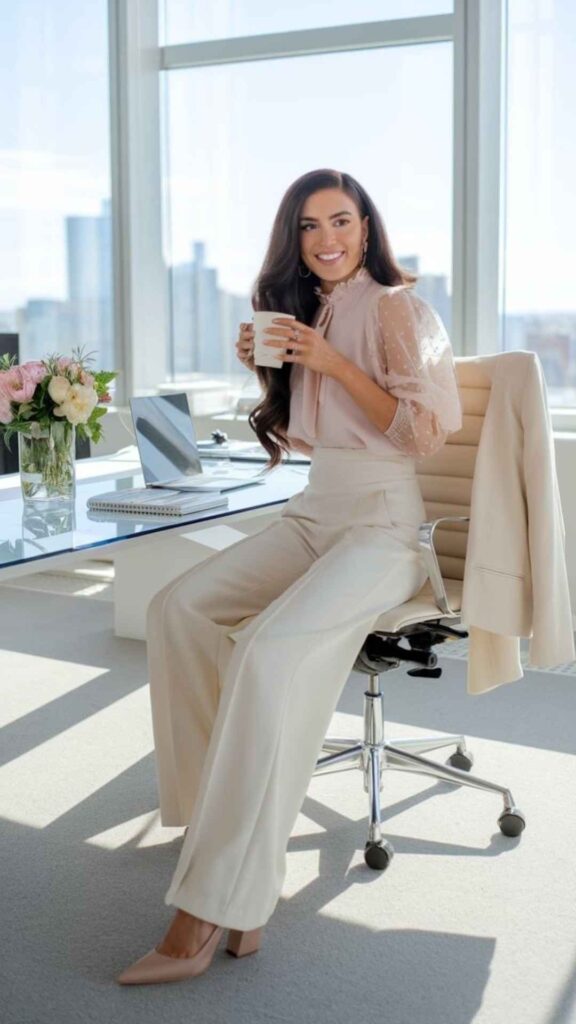
Business casual isn’t one-size-fits-all. The same dress code label reads very differently depending on where you work. Understanding your specific workplace’s interpretation of office dress code outfits is just as important as knowing the general rules. Pay attention to what the most respected women in your organization wear their choices tell you everything.
Outfits for corporate meetings women need to nail will differ significantly from what works for a casual Tuesday in a startup office. Calibrating to your environment doesn’t mean losing your personal style. It means expressing that style within the appropriate framework for your specific professional context.
Corporate Office Business Casual
In corporate environments think finance, banking, consulting, and law-adjacent roles business casual leans decidedly more formal. Formal work outfits women wear in these settings typically include structured blazers in neutral tones, tailored trousers or midi skirts, silk or high-quality blouses, and closed-toe heels or polished loafers. Color palettes trend toward navy, black, charcoal, and camel with minimal pattern play.
The unspoken rule in corporate settings is that your clothing should never be the most memorable thing about you in a room. It should communicate competence and attention to detail without drawing excess attention. Fit is everything here even a simple outfit in a muted color looks impeccable when it fits perfectly. Corporate professional clothing sets women should invest in include a quality blazer-trouser set and at least two formal blouses that can rotate through the week.
Startup and Tech Office Outfits
Tech and startup environments operate at the relaxed end of business casual sometimes crossing into smart casual women outfits territory. Dark jeans are almost universally acceptable. Clean sneakers often make an appearance. Blazers show up when meetings call for them rather than as daily wear. The overall vibe is elevated basics: quality fabrics, clean lines, minimal branding, and comfortable cuts.
Professional outfits that look stylish in tech environments often center around elevated basics a great-fitting crewneck in a premium fabric, tailored joggers or wide-leg pants in technical fabrics, or a sleek midi dress in a solid color. The goal is looking intentional without looking like you tried too hard. In these environments, work fashion for women rewards personal style more than most so don’t be afraid to incorporate color, interesting textures, or fashion-forward silhouettes.
Hybrid and Remote Work Looks
How to build a work wardrobe for women who split their time between home and office? Think of it as two overlapping wardrobes with significant crossover. For remote days, comfortable office outfits for long days at your desk might mean wide-leg knit pants with a structured blouse comfortable from the waist down, completely professional from the waist up for video calls.
For hybrid workers, versatility is the supreme value. Every piece you buy should work both at home and in the office. Ponte pants and structured jersey pieces are ideal they look polished on camera but feel like yoga pants in terms of comfort. Building a capsule wardrobe for office wear women who work hybrid schedules means choosing pieces that photograph well on video, don’t wrinkle in transit, and transition easily between desk, commute, and office floor.
Read More About: Summer Outfits for Women: 35 Trendy, Cute & Stylish Looks for 2026
Seasonal Business Casual Outfits for Women
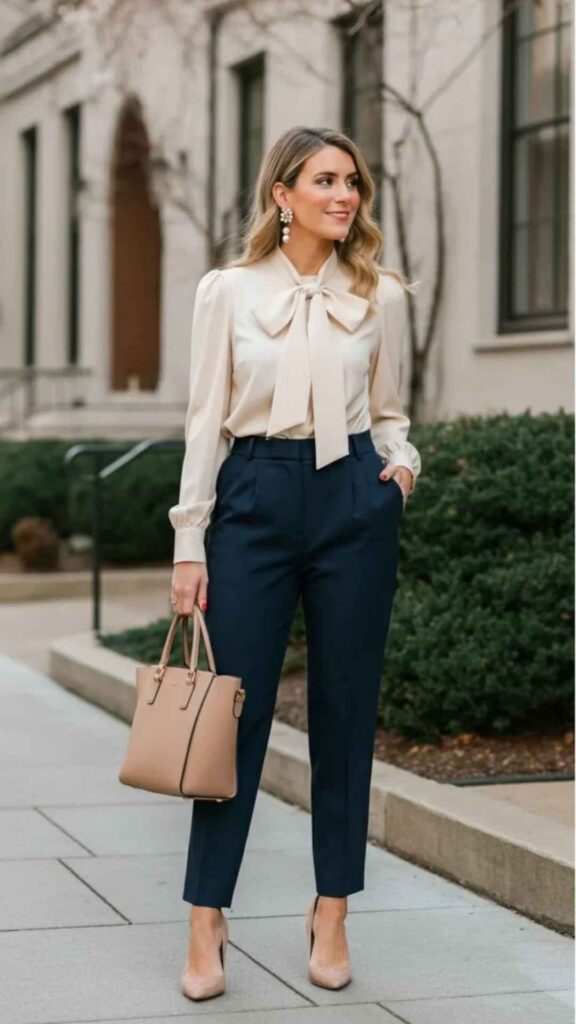
One of the most practical skills any professional woman can develop is dressing appropriately across all four seasons without rebuilding her wardrobe from scratch every few months. The best work wardrobe essentials women need are those that can layer, transition, and adapt with only minor adjustments for temperature and occasion.
Office outfit ideas for Monday to Friday across all four seasons come from understanding which core pieces work year-round and which ones are truly seasonal investments. Below is a practical breakdown of how to adapt your business casual outfits for women through every season of the American calendar.
Spring Business Casual
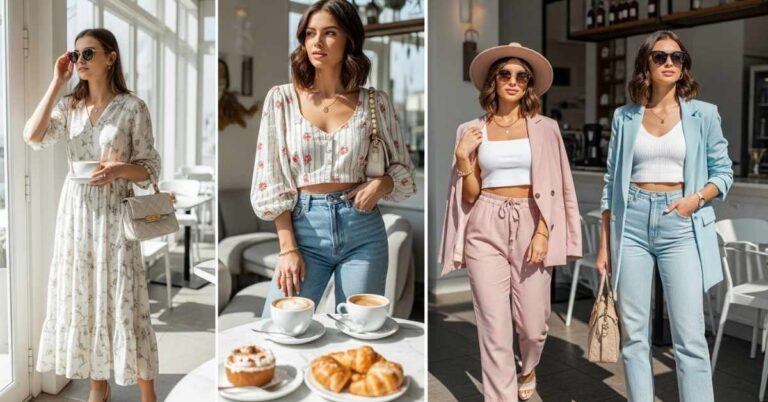
Spring business casual is about lightness lighter fabrics, softer colors, and easier layering. Linen blazers replace heavy wool ones. Floral midi skirts, blush trousers, and chambray button-downs come out of hibernation. Pastel tones work beautifully in spring women’s workwear without looking unprofessional the key is keeping the silhouette and fit structured even as the color palette softens.
Transitional spring days call for intelligent layering. A light trench coat over a wrap dress with pointed flats is a perfect spring office outfit for women it handles variable temperatures while looking completely polished from door to desk. Spring is also a great time to experiment with subtle prints: a small floral blouse tucked into solid-color tailored trousers adds personality without overwhelming your professional image.
Summer Business Casual
Summer presents the most common challenge in professional attire for women how do you stay cool without compromising professionalism? The answer lies entirely in fabric choice. Linen, lightweight cotton, crepe, and moisture-wicking technical fabrics keep you comfortable in summer heat while still looking polished. Heavy polyester and thick wool are completely off the table.
Sleeveless blouses and dresses are completely appropriate for business casual in summer but keep a lightweight blazer or structured cardigan at your desk for air-conditioned conference rooms. Sleeveless doesn’t mean revealing; there’s a significant difference between a sleeveless silk blouse and a spaghetti-strap sundress. Summer office appropriate outfits women love include linen wide-leg trousers with a tucked cotton blouse, shirt dresses in breathable fabrics, and ponte midi skirts with lightweight knit tops.
Fall Business Casual
Fall is arguably the best season for modern office outfits women who love layering. Rich earth tones — rust, burgundy, camel, forest green, and deep navy dominate fall workwear collection women build for the cooler months. Turtlenecks return with genuine enthusiasm. Wool blazers and structured cardigans come back into rotation. Loafers in cognac or dark brown feel perfectly seasonal.
The layering game in fall business casual is genuinely enjoyable. A camel turtleneck under an olive blazer with black wide-leg trousers and brown loafers is one of the most satisfying fall work outfits in existence. It’s warm, it’s polished, and it photographs brilliantly for the inevitable autumn LinkedIn headshots. Fall also introduces richer textures herringbone, houndstooth, and subtle tweed all add depth and sophistication to tailored office wear women love this time of year.
Winter Business Casual
Winter business casual is about staying warm without looking like you raided a ski lodge. The solution is layering with intention. A silk blouse under a structured blazer under a wool-blend coat creates a professional silhouette that handles even brutal American winters with grace. Thermal underlayers in fine-gauge merino wool are completely invisible under your clothes but add meaningful warmth.
Professional clothing sets women find most useful in winter include wool-blend blazer and trouser combinations, thick ponte dresses, and cashmere or merino turtlenecks. Dark, rich color palettes dominate black, charcoal, deep burgundy, midnight navy. Knee-high boots in leather or faux leather replace summer sandals and add warmth without sacrificing an ounce of professionalism. The goal in winter office outfits for women is looking deliberately styled, not just bundled up.
Read More About: Summer Outfits: 25 Stunning Stylish Summer Outfit Ideas for Women in 2026
How to Build a Business Casual Capsule Wardrobe
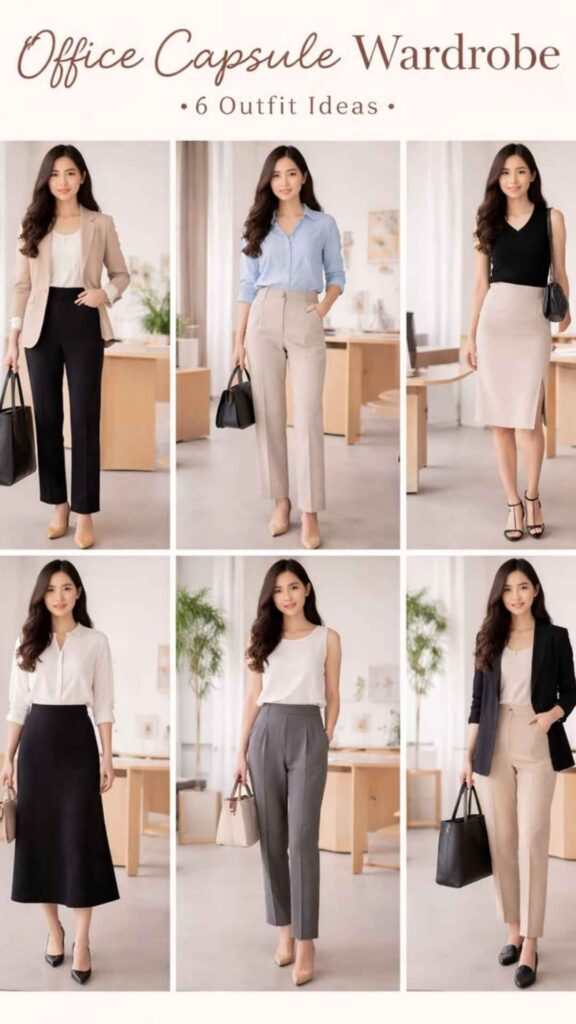
A capsule wardrobe for office wear women is a small, intentionally curated collection of versatile pieces that mix and match to create a large number of outfits. The concept originated with fashion designer Susie Faux in the 1970s and was popularized by Donna Karan’s iconic “Seven Easy Pieces” collection in 1985. The principle is simple: own fewer, better things and dress better as a result.
How to build a work wardrobe for women using the capsule approach starts with ruthless clarity about what you actually need versus what you think you need. Most professional women wear about 20% of their wardrobe 80% of the time. The capsule approach flips that dynamic every piece earns its place by working with everything else.
10 Essential Pieces Every Woman Needs
These ten pieces form the foundation of a complete professional wardrobe for women in any industry:
- Tailored blazer in a neutral color (black, navy, or camel)
- White or ivory button-down shirt in crisp cotton or silk
- Silk or satin blouse in a versatile neutral or soft color
- Wide-leg or straight-cut tailored trousers in black or navy
- Pencil or midi skirt in a structured fabric
- Sheath or wrap dress in a solid, professional color
- Fitted crewneck or turtleneck sweater in a quality knit
- Dark-wash straight-cut jeans with no distressing
- Classic loafers or pointed-toe flats in a neutral leather
- Structured tote or work bag in a quality neutral leather or vegan alternative
These ten pieces alone generate over thirty unique outfit combinations which means office outfit ideas for Monday to Friday for multiple weeks without repeating. That’s the power of a properly built capsule wardrobe.
Mixing and Matching Outfits Efficiently
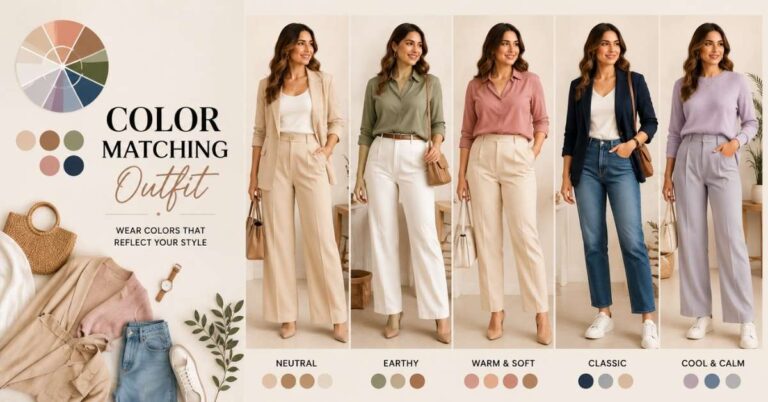
The secret to maximizing a capsule wardrobe for office wear women is color cohesion. Build your capsule around three neutrals say, black, ivory, and camel plus one accent color that complements all three, like navy or burgundy. Every piece you own should work with at least three other pieces in your wardrobe. If a new purchase only pairs with one other thing, it’s not a capsule piece.
Best pants and blazers for office women in a capsule context are always neutral because neutrals pair with everything. A black blazer pairs with your navy trousers, your cream blouse, your dark jeans, and your midi skirt equally well. That single blazer appears in at least eight different outfit combinations. The math of a capsule wardrobe is simple and deeply satisfying invest once, dress well repeatedly, stress never.
Can Women Wear Jeans in a Business Casual Office?
This is one of the most frequently asked questions about business casual outfits for women and the answer is a qualified yes. Jeans can absolutely be appropriate in a business casual environment. The word “can” carries a heavy emphasis on context, though. Not all jeans are created equal. And not all workplaces are equally receptive to denim in the office.
What is business casual for women when it comes to jeans? It’s the version of denim that looks polished rather than casual. The difference between office-appropriate jeans and casual jeans is entirely about wash, cut, condition, and styling. Get those four factors right and your jeans belong in the office. Get them wrong and no amount of a great blazer will save you.
Acceptable Jean Styles
Dark wash is non-negotiable. Any jean lighter than a medium wash starts to look casual regardless of how it’s styled. Straight-cut and slim-fit silhouettes are the most professional options they have a clean, tailored line that reads as intentional. Wide-leg jeans are increasingly accepted in creative and tech environments, particularly in a dark wash with a structured top.
The condition of your jeans matters enormously. No distressing, no fading, no rips even deliberate fashion rips are firmly off the table in professional settings. Your jeans should look pristine, as if they were purchased recently and cared for properly. Style them with elevated pieces: a silk blouse, a structured blazer, heeled loafers, or pointed-toe flats. A structured bag completes the picture. Done correctly, dark-wash jeans with a blazer and silk blouse look completely professional in the vast majority of business casual American offices.
When Jeans Are Not Appropriate
Even in a business casual office, some situations call for leaving the jeans at home. Client presentations, formal meetings, job interviews, and any event with external stakeholders are contexts where jeans communicate the wrong message regardless of how polished the styling is. If you’re meeting someone important for the first time or representing your company in a formal capacity, choose trousers instead.
Industry matters enormously here too. Finance, law-adjacent roles, and traditional corporate environments often have an unspoken “no jeans” understanding even when the official dress code says business casual. When you start a new job, observe before you experiment. Let your environment tell you what’s truly acceptable before testing the boundaries with denim.
Business Casual Dos and Don’ts for Women
Understanding the rules of business casual matters. But knowing the common mistakes matters just as much maybe more. Many women who genuinely care about professional attire unknowingly undermine their image through small, fixable errors. The good news: once you know what they are, avoiding them takes almost no extra effort.
How to dress professionally but comfortably is a question about balance and the dos and don’ts below reflect that balance. Professionalism isn’t about discomfort or rigidity. It’s about intention, quality, and respect for your environment.
Common Mistakes to Avoid
The most common mistake is wearing clothes that don’t fit properly. Clothes that are too big look sloppy and untidy regardless of how expensive they are. Clothes that are too small look uncomfortable and draw attention for the wrong reasons. Fit is the single most important variable in professional dressing and it’s correctable with a basic tailor relationship.
Wearing wrinkled or visibly worn fabric is another significant mistake. Wrinkled clothes signal carelessness. Pilled knits, faded colors, or scuffed shoes all communicate that you haven’t paid attention. Iron or steam your clothes the night before. Keep your shoes clean and polished. These small acts of care make an enormous visual difference. Overly casual footwear think flip-flops, heavily worn sneakers, or UGG-style boots also consistently undermines otherwise professional outfits.
And visible undergarments or overly revealing necklines and hemlines, while technically a personal choice, will often work against you in professional environments where first impressions and sustained credibility matter.
How to Add Personal Style Professionally
Stylish yet professional clothing for work is absolutely achievable you don’t need to erase your personality to look professional. Color is your first lever. A bold cobalt blazer instead of black is just as professional in most environments but infinitely more memorable. Textural interest a bouclé jacket, a silk scarf, a leather belt adds visual depth without sacrificing professionalism.
Accessories are where personal expression lives most comfortably in a professional wardrobe. Statement earrings with a neutral outfit. A printed scarf tied around the handle of a work bag. A signature ring or a beautiful watch. These small choices communicate taste and individuality without ever crossing a professional line. Chic work outfits women create from standard pieces often come down to exactly these kinds of small, considered additions.
Business Casual for Job Interviews
Dressing for a job interview deserves its own conversation because the stakes are higher and the audience is less familiar with you. Your interview outfit is forming a first impression for people who will decide your professional future. It needs to communicate competence, respect, and personal investment without feeling costume-like or uncomfortable.
The general rule for business casual for job interviews is to dress one level above what you believe the daily dress code to be. If the company operates at relaxed business casual, show up in polished, structured business casual. If they’re business professional, match that standard precisely. When in doubt, err formal. Nobody has ever lost a job offer for looking too polished in an interview.
Interview Outfit Examples
A classic and reliably excellent interview outfit for most industries: structured blazer in black or navy, tailored trousers in a matching or complementary neutral, a silk blouse in ivory or soft white, and pointed-toe loafers or block heels. This combination reads as serious, prepared, and stylish without being overdressed. Add a structured bag, simple jewelry, and clean shoes you’re completely interview-ready.
For a more creative industry interview, you have more freedom. A wrap dress in a sophisticated color or subtle print with a blazer and block heels communicates both professionalism and personal style. A button-down shirt with wide-leg trousers in an interesting color shows fashion awareness within a professional framework. The goal in every case is looking like the best, most polished version of your daily self not a stranger in formal wear.
What to Wear by Industry
Different industries read interview clothing differently. In finance and law, conservative is always correct stick to dark neutrals, structured pieces, and minimal accessories. In marketing, PR, and media, slightly more personality is welcome and even expected a carefully chosen print or an interesting color reads as culturally aware rather than inappropriate. In tech and startups, smart casual can suffice but polished business casual is always respected.
| Industry | Interview Outfit Approach | Key Pieces |
| Finance & Law | Conservative, traditional | Dark blazer, tailored trousers, silk blouse |
| Marketing & Media | Polished with personality | Print blouse, structured skirt, blazer |
| Tech & Startups | Smart casual to business casual | Dark jeans, blazer, quality blouse |
| Healthcare Admin | Clean, neat, practical | Ponte pants, blouse, comfortable flats |
| Education | Approachable and professional | Wrap dress, cardigan, flat loafers |
Modern Business Attire for Women in 2026
The world of modern business attire for women has undergone a genuine transformation over the past several years. The rigid formality of pre-2020 office fashion has been replaced by something more nuanced, more personal, and frankly more interesting. Today’s professional wardrobe for women reflects a broader cultural shift toward authenticity and intention over conformity.
Updated office dress codes across America now explicitly acknowledge flexibility in a way they never did before. Many companies have abandoned the “business casual” label altogether in favor of language like “professional and appropriate” or “dress for your day” acknowledging that what you wear to a client presentation differs from what you wear on a quiet writing day at your desk.
Current Workplace Fashion Trends
The dominant aesthetic in women office fashion right now is quiet luxury think high-quality fabrics in muted, sophisticated tones, clean silhouettes, and minimal branding. Expensive-looking but not flashy. The influence of brands like The Row, Totême, and Loro Piana has trickled down to accessible retailers who now stock incredibly well-made basics in the quiet luxury aesthetic.
Wide-leg trousers have completely replaced the skinny pant in most progressive American offices. The loafer has firmly displaced the stiletto as the power shoe of choice combining sophistication with genuine all-day wearability. Soft tailoring blazers and trousers that are structured but not stiff dominates the workwear collection women are currently building. And the monochromatic outfit head-to-toe in one color or closely related tones has become a sophisticated staple of modern office outfits women who want to look effortlessly put-together.
Updated Office Dress Codes
Post-pandemic workplace culture permanently changed what American employers expect from work clothing for women in the office. The return-to-office movement brought with it a renegotiated dress code one that acknowledges the comfort workers discovered at home while maintaining professional standards for an in-person environment.
Most major companies have updated their dress code policies to reflect this new reality. Formal suits are no longer the expectation in most offices outside of specific professional sectors. Clean sneakers are explicitly permitted in many updated employee handbooks. The emphasis has shifted from specific garment requirements to broader standards of cleanliness, fit, and appropriateness. This shift works in your favor it gives you genuine room to build a professional wardrobe for women that reflects your personal style while meeting professional expectations.
Business Casual Outfit Mistakes That Make You Look Unprofessional
Even well-intentioned, style-conscious women make mistakes in their office dress code outfits. Most of these errors aren’t about wearing the wrong clothes they’re about overlooking important details that undermine an otherwise solid outfit. Here are the most common ones:
Poor fit is the number one offender. Clothes that gap, pull, sag, or bunch anywhere compromise your entire appearance regardless of how expensive or stylish the pieces are. Find a good tailor and use them hemming trousers and taking in a blazer costs very little and makes an enormous difference.
Visible undergarments including bra straps, underwear lines, and visible through sheer fabrics all distract from your professional image. A quality seamless undergarment collection is one of the best investments a professional woman can make.
Overly casual footwear especially worn, dirty, or visibly informal shoes drags down even a polished outfit. Your shoes should always be clean, in good condition, and appropriate to the formality level of the rest of your outfit.
Clashing or excessive accessories create visual noise that reads as disorganized. Stick to two or three intentional accessories per outfit maximum.
Wrinkled or pilled fabric signals carelessness. Invest in a good steamer. Use it the night before. Your future self will thank you every morning.
Ignoring your company culture is perhaps the most strategic mistake. Dressing in a way that’s technically within dress code but clearly out of step with your specific workplace culture sends a signal that you’re not paying attention to your environment.
FAQ’s
What is the difference between business casual and business professional?
Business professional is the more formal of the two dress codes. It typically involves a full matching suit or structured blazer with formal trousers or a skirt, a formal blouse, and closed-toe heels. It’s what you’d wear to a formal board meeting, court appearance, or high-stakes client presentation. Business casual is more relaxed it includes many of the same pieces but allows for more mix-and-match flexibility, a broader color palette, and less rigid formality. Think of business professional as a pressed uniform and business casual as its more expressive, approachable sibling
What is the difference between smart casual and business casual?
Smart casual is less formal than business casual. While business casual still requires polished, office-appropriate pieces like blazers, tailored trousers, and professional shoes, smart casual allows for a wider range of relaxed clothing fashion-forward jeans, stylish sneakers, and trendier pieces that wouldn’t always fly in a traditional office. Smart casual is what you’d wear to a nice dinner, a creative event, or a very relaxed Friday office. Business casual is what you’d wear to represent yourself professionally in an office environment on any given workday.
What shoes are not business casual?
Flip-flops, heavily worn sneakers, UGG-style boots, athletic running shoes, rubber clogs, heavily platform shoes, and strappy party sandals are generally not appropriate for business casual environments. The guiding principle is that your shoes should look intentional and professional clean, in good condition, and suited to the formality level of your outfit and workplace.
Can leggings be business casual?
In most traditional business casual environments, standard leggings are not appropriate. They’re too casual and too body-hugging for a professional setting. However, ponte leggings a thicker, more structured fabric that resembles a knit pant can pass in very relaxed workplaces when styled carefully with a long blazer or tunic and proper footwear. If you’re questioning whether your leggings cross the line, they probably do. Opt for tailored trousers or ponte pants instead they’re often just as comfortable but fully professional.
Conclusion
Business casual women doesn’t need to be confusing or stressful. At its core, it’s simply about looking intentional, polished, and appropriate for your specific professional environment. You don’t need a bottomless wardrobe budget. You don’t need to follow every trend. You need quality basics that fit well, a clear understanding of your workplace’s specific culture, and a handful of key pieces that work together seamlessly.Start with the capsule approach.
Invest in a great blazer, two pairs of tailored trousers, a silk blouse, a quality dress, and a structured bag. Build from there with seasonal additions and personal style touches. Focus obsessively on fit it matters more than price, brand, or trend. And remember that professional attire for women in 2026 is more flexible, more personal, and more comfortable than it’s ever been. That’s genuinely good news for every woman getting dressed for work tomorrow morning.