
Connectivity HSSGamepad: Complete Guide to Better Gaming (2026
You press a button. Nothing happens. Then, half a second later, your character finally moves. By then, you’re already dead. Sound familiar? That gap between your thumb and the screen is what we call connectivity HSSGamepad, and it’s the real reason most gamers lose fights they should have won.
This guide walks you through everything about HSSGamepad connectivity. You’ll learn what causes input lag, why your wireless gamepad keeps dropping, and how to build a setup that just works. No fluff. Just real fixes, written in plain English, for every platform you actually use in 2026.
What Is Connectivity HSSGamepad?
Connectivity HSSGamepad is the full path your input takes. It starts the moment you press a button. It ends when your game engine reacts. Along the way, your signal passes through firmware, a wireless signal or a cable, and a receiver. Every step adds a small delay. Add them together, and you get your total controller latency.
Most gamers think connectivity just means Bluetooth. That’s wrong. It covers every method your gaming controller uses to talk to your device, whether that’s a Bluetooth game controller, a 2.4GHz dongle, or a plain USB wired connection. Understanding this full picture is the first step toward fixing controller not responding problems for good.
What the Term Means in Real Gaming
Think of your controller like a messenger running a relay race. Your thumb hands off the baton first. The controller’s chip processes it next. Then the signal transmission carries it across open air or a cable. Finally, your console or PC catches the baton and acts on it. If any runner in that chain slows down, your whole response time suffers.
This matters because gaming rewards speed. A racing game needs precise button response. A fighting game needs frame-perfect timing. An FPS needs your shot to land the instant you pull the trigger. When connection stability breaks down, none of that works the way it should, no matter how good your reflexes actually are.
How HSSGamepad Connects to Different Devices
Your HSSGamepad can pair with more devices than most people realize. It works with Windows PCs, Android phones, iPhones running iOS, Smart TVs, and streaming boxes like Fire TV. Each device type handles wireless connectivity a little differently, and each one has its own quirks worth knowing.
Some devices support Bluetooth pairing mode only. Others let you plug in a USB receiver for a more stable link. A few even support both, letting you switch based on what you’re doing that day. Knowing which method your specific device supports saves you a lot of guesswork later in this guide.
Why Stable HSSGamepad Connectivity Matters
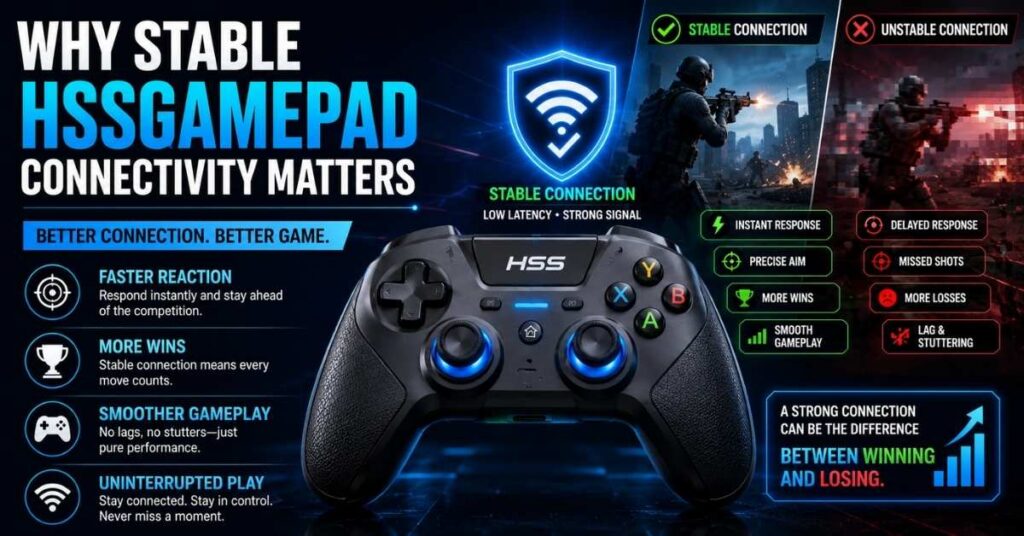
A stable connection isn’t a luxury. It’s the foundation of good gaming performance. Gamers spend hundreds of dollars upgrading their rigs, yet ignore the one thing sitting right in their hands. A shaky connection cancels out almost every hardware upgrade you make, because your input never reaches the game cleanly in the first place.
Low latency gaming depends entirely on connection quality. It shapes your reaction time in shooters, your precision in racing games, and your combo timing in fighting games. Even open-world games suffer, since delayed movement makes exploring feel sluggish and unnatural. Fix your connection first, and everything else starts to feel sharper.
How Connection Quality Affects Gameplay
Every genre punishes bad wireless gaming performance differently. In competitive shooters, a hundred milliseconds of delayed response can mean the difference between landing a kill and getting eliminated first. In rhythm or fighting games, that same delay throws off your entire combo, even if your execution was perfect.
Racing games are just as unforgiving. A late steering input means missing your braking point, which costs you the corner. Even casual games suffer quietly, since gaming latency makes movement feel heavy and unresponsive. Once you notice it, you can’t unnotice it, and that’s exactly why fixing it matters so much.
Real Gaming Example: Low Latency vs High Latency
Imagine two players in the same competitive shooter. Player one uses a wired game controller with near-zero delay. Player two uses an aging wireless gamepad suffering from Bluetooth interference. Both players press jump at the exact same moment.
Player one jumps instantly and dodges the incoming shot. Player two’s jump registers late, and they take the hit instead. That’s the entire difference between winning and losing, and it had nothing to do with skill. It came down purely to stable gameplay versus a shaky one.
How Connectivity HSSGamepad Works
Understanding the mechanics behind your connection makes troubleshooting far easier later on. Every HSSGamepad uses one of three main connection types, and each one comes with its own strengths, weaknesses, and ideal use case depending on what kind of gaming you do.
Knowing the difference between Bluetooth connection, 2.4GHz wireless, and USB wired connection helps you pick the right setup for the moment. Casual couch gaming has different needs than a ranked competitive match, and your connection choice should reflect that.
Read More: 11 Best Wireless Earbuds Under $100 in 2026 (Tested & Expert Reviewed)
Bluetooth Connectivity
Bluetooth connectivity works through short-range radio waves, using something called the Bluetooth HID protocol to communicate with your device. It’s convenient, widely supported, and doesn’t require any extra hardware. Most phones, tablets, and modern TVs support it right out of the box.
The tradeoff is speed. Bluetooth typically introduces more delay than other methods, especially when Bluetooth compatibility issues or older Bluetooth versions come into play. It’s a solid choice for casual play, but competitive gamers usually look elsewhere for the lowest latency controller connection.
2.4 GHz Wireless Connection
A 2.4GHz dongle creates a dedicated wireless channel between your controller and your device, separate from your everyday Bluetooth traffic. This tends to deliver a stable wireless connection with noticeably less delay than standard Bluetooth pairing.
Because it uses its own wireless receiver, it avoids a lot of the congestion that slows Bluetooth down. Many competitive gamers treat this as the sweet spot between convenience and performance, especially when a wired setup isn’t practical.
USB Wired Connection
A USB wired connection removes wireless variables from the equation entirely. Your signal travels directly through a USB data cable, with no signal interference and no wireless congestion to worry about. This is why a USB game controller setup remains the gold standard for competitive gaming.
The only downside is convenience. You’re tethered to your device, which limits movement and setup flexibility. Still, if you care about low latency gaming above everything else, wired remains undefeated.
Latency Comparison Between Connection Types
The table below breaks down how each method performs in real-world conditions.
| Connection Type | AverageLatency | Stability | Best For |
| USB Wired Connection | 1–5 ms | Very High | Competitive gaming |
| 2.4GHz Wireless | 2–10 ms | High | Balanced everyday play |
| Bluetooth Connection | 80–250 ms | Medium to Low | Casual gaming |
This latency comparison makes the pattern clear. Wired wins on raw speed. Wireless wins on freedom. Your choice should match how seriously you’re playing that day.
Common Connectivity HSSGamepad Problems
Most complaints about a gaming controller fall into a short list of repeat offenders. Once you recognize the pattern, diagnosing your own issue becomes much faster, since you’re no longer guessing blindly at what might be wrong.
Below, we’ll walk through the six most common problems gamers report, along with what each one actually feels like during a session.
Input Lag and Delayed Response
Input lag is the most reported issue by far. It shows up as controller lag, sluggish camera movement, or shots that fire a beat too late. Players often describe it as their character feeling stuck behind their own hands, which is a surprisingly accurate way to put it.
This kind of delayed response usually points back to connection type or wireless congestion, rather than a broken controller. Before assuming your hardware failed, check your connection method first.
Random Bluetooth Disconnects
Random disconnects happen without warning, often right in the middle of a match. You’ll hear a disconnect beep, watch your character freeze, and then wait through an awkward reconnection delay while your opponent keeps moving.
These connection drops are almost always tied to battery level, distance, or competing wireless traffic nearby. It’s frustrating, but it’s also very fixable once you know where to look.
Pairing Problems
A pairing failure stops your controller from connecting at all. You might see a “device not found” message, or your controller gets stuck flashing in pairing mode without ever locking on.
Pairing conflicts often come from old saved connections still lingering in your device’s memory, confusing the system about which controller to talk to.
Signal Interference
Modern homes are noisy places wirelessly. Routers, smartphones, wireless headphones, and smart speakers all compete for the same crowded frequency space, creating constant Wi-Fi interference for anything nearby.
This kind of signal interference chips away at your signal strength, even if you never notice the other devices actively working in the background.
Controller Freezing or Stuttering
Stuttering feels different from full disconnects. Movement freezes for a split second, inputs skip frames, and the whole game suddenly feels jerky instead of smooth.
This usually points to unstable signal transmission, rather than a total connection failure. It’s a warning sign that something in your setup needs attention soon.
Controller Connects but Doesn’t Respond
Sometimes your controller connects successfully but simply won’t respond to any input. This often traces back to outdated HID drivers, conflicting entries in Device Manager, or a leftover ghost pairing confusing your system.
This is one of the more confusing problems gamers face, since everything looks connected on the surface while nothing actually works underneath.
What Causes HSSGamepad Connectivity Issues?
Now that you know the symptoms, let’s dig into the real causes behind them. Fixing the surface problem without understanding the root cause usually leads to the same issue coming back a few days later.
Here’s a breakdown of the seven most common culprits behind unreliable HSSGamepad connectivity.
Wireless Signal Interference
The 2.4GHz band gets crowded fast. Wi-Fi routers, Bluetooth peripherals, and smart home devices all share this same narrow slice of spectrum, creating constant background noise for your controller to fight through.
Reducing nearby wireless clutter is one of the simplest ways to improve wireless connectivity almost immediately.
Low Battery Performance
A controller battery running low doesn’t just risk shutting off. It actively weakens signal strength, shortening your effective range and increasing the odds of dropouts during a session.
Battery health matters more than most players realize when it comes to maintaining a truly stable wireless connection.
Distance Between Controller and Device
Distance quietly degrades your wireless signal over time. Bluetooth generally performs best within two to three meters of your device, and walls or furniture in between make things worse.
Keeping your setup compact and obstacle-free goes a long way toward avoiding unnecessary signal loss.
Outdated Firmware or Drivers
Old software creates hidden communication errors between your controller and your device. A missing firmware update or an outdated driver update can quietly cause pairing failure, lag spikes, and inconsistent timing.
Manufacturers release these updates specifically to patch bugs like these, so skipping them leaves known problems unsolved.
Bluetooth Version Compatibility
Not all Bluetooth versions perform equally. Bluetooth 5.0 and newer offers the best stability and range. Bluetooth 4.x is still usable but noticeably weaker. Anything older than that carries a real risk of constant lag.
Checking your device’s Bluetooth version is a quick way to rule out a hardware limitation early on.
Too Many Connected Wireless Devices
Every additional connected device eats into your available bandwidth. A controller, a headset, a phone, and a wireless mouse all sharing the same space creates real wireless congestion.
Disconnecting devices you’re not actively using frees up room for your controller’s signal to breathe.
Incorrect Connection Mode
Sometimes the fix is simpler than people expect. Using Bluetooth connection for a competitive session when a 2.4GHz dongle or wired option was available the whole time is a common, easily avoidable mistake.
Matching your connection mode to the situation prevents a lot of unnecessary frustration.
Read More: Best Wireless Earbuds Under 200 Dollars 2024: 11 Premium Picks for Amazing Sound
Step-by-Step Fixes for Connectivity HSSGamepad
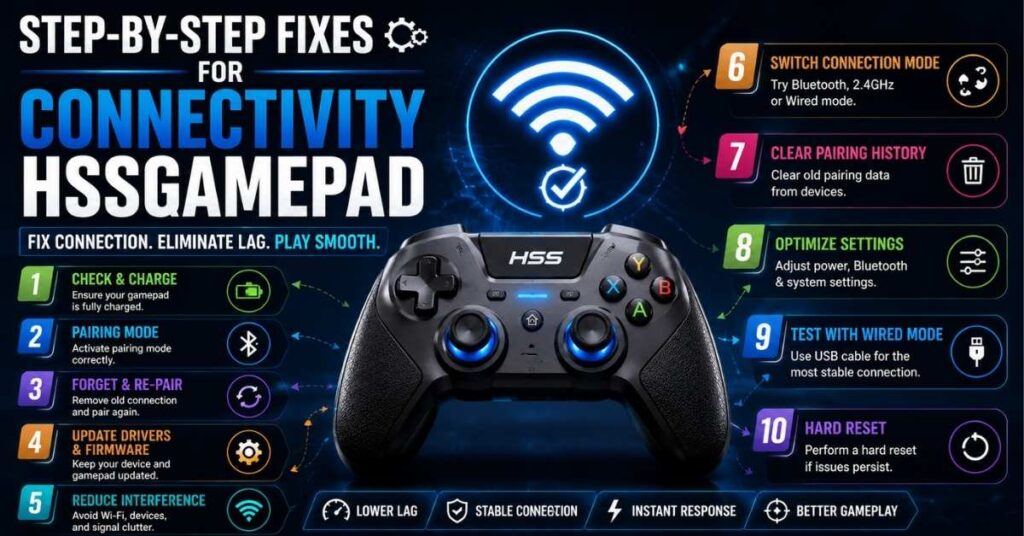
With causes identified, it’s time to actually fix things. Below are ten proven steps to improve controller connectivity, ordered from the simplest quick wins to the more advanced troubleshooting techniques.
Fix 1: Fully Charge the Controller
Start with the basics. A low controller battery weakens your signal before anything else even comes into play. Charge fully before any long session, and try to avoid playing below twenty percent whenever possible.
Fix 2: Enable Pairing Mode Correctly
Many pairing failure issues come from skipping a step. Hold the correct button combination until the light pattern changes, confirming your controller has actually entered proper pairing mode rather than just powering on.
Fix 3: Forget and Re-Pair the Controller
A clean reset solves more problems than people expect. Remove the saved device from your Bluetooth list, restart the controller fully, then reconnect game controller from scratch for a fresh connection.
Fix 4: Update Firmware and Device Drivers
Check for a pending firmware update on your controller, along with any available driver update for your device’s Bluetooth or USB hardware. These updates often quietly resolve firmware compatibility issues you didn’t even know existed.
Fix 5: Reduce Wireless Interference
Move your router farther from your gaming area. Turn off nearby Bluetooth devices you’re not using. These small changes meaningfully reduce wireless interference without costing you anything.
Fix 6: Switch Between Bluetooth, Dongle, and USB Mode
If one connection type keeps failing, try another. Comparing Bluetooth vs 2.4GHz performance for your specific setup often reveals a clear winner you didn’t expect.
Fix 7: Hard Reset the HSSGamepad
A controller reset clears out any stuck internal state causing erratic behavior. Most controllers support this through a small reset button or a specific held button combination.
Fix 8: Clear Old Bluetooth Pairing History
Old, duplicate, or ghost connections confuse your device about which signal to trust. A full Bluetooth reset on your device’s paired list often clears up stubborn ghost pairing problems for good.
Fix 9: Optimize Power Management Settings
Aggressive power management settings on your PC often throttle Bluetooth radios to save energy. Disabling USB selective suspend and easing up on battery optimization settings usually restores full performance.
Fix 10: Test Using a Wired Connection
When nothing else works, plug in directly. A wired gaming test instantly tells you whether your issue is truly wireless-related or something deeper within the controller itself.
Platform-Specific Connectivity Setup
Every platform handles wireless controller setup a little differently. Below is a quick breakdown for the devices most American gamers actually use day to day.
Android Phones and Tablets
Android game controller setup usually works through standard Bluetooth pairing inside your system settings. It’s worth checking your Android battery optimization settings too, since aggressive power saving can quietly interrupt background connections during longer sessions.
Windows PC
PC game controller setup on Windows relies heavily on your Windows HID driver installation. Checking Device Manager for any yellow warning icons is usually the fastest way to spot a driver conflict before it causes bigger problems.
iPhone and iPad (iOS)
iPhone game controller pairing works through the Bluetooth settings menu, similar to Android. Apple maintains a fairly strict compatibility list, so confirming support for your specific controller model avoids wasted troubleshooting time later.
Android TV and Fire TV
These streaming boxes generally support the same Bluetooth pairing process as phones and tablets. Distance matters more here, since the box often sits farther from your couch than a handheld device would.
Smart TVs
Smart TV compatibility varies quite a bit between manufacturers and model years. Some TVs support direct Bluetooth pairing natively, while older models may need a separate wireless receiver plugged into a USB port instead.
Gaming Consoles (If Supported)
Console support depends entirely on manufacturer licensing agreements, so hardware compatibility should always be confirmed directly through official specifications before assuming full functionality across every feature.
Troubleshooting Table: Problem, Cause, and Solution
This quick-reference table pulls together everything covered so far into one place.
| Problem | Likely Cause | Recommended Fix |
| Input lag | Wireless delay | Switch to wired or 2.4GHz |
| Random disconnects | Low battery | Recharge fully before playing |
| Pairing failure | Old saved device memory | Clear Bluetooth history and re-pair |
| Stuttering | Signal interference | Reduce nearby wireless devices |
| Controller not detected | Firmware or driver mismatch | Install latest firmware update |
| Connects but unresponsive | Ghost pairing or driver conflict | Check Device Manager and reset |
Wired vs Wireless HSSGamepad Connectivity
Choosing between wired and wireless ultimately depends on what kind of gaming you’re doing. Neither option is universally better. Each one simply fits a different situation and a different type of player.
Which Connection Is Best for Competitive Gaming?
For ranked matches and tournaments, a wired game controller remains the safest bet. It eliminates interference entirely and delivers the lowest latency controller connection available, which matters enormously when every millisecond counts.
When Bluetooth Is the Better Choice
For casual couch sessions, Bluetooth connectivity offers freedom of movement that wired setups simply can’t match. If you’re not chasing leaderboard rankings, the small latency tradeoff is usually well worth the added convenience.
Best Practices to Keep Your HSSGamepad Connection Stable
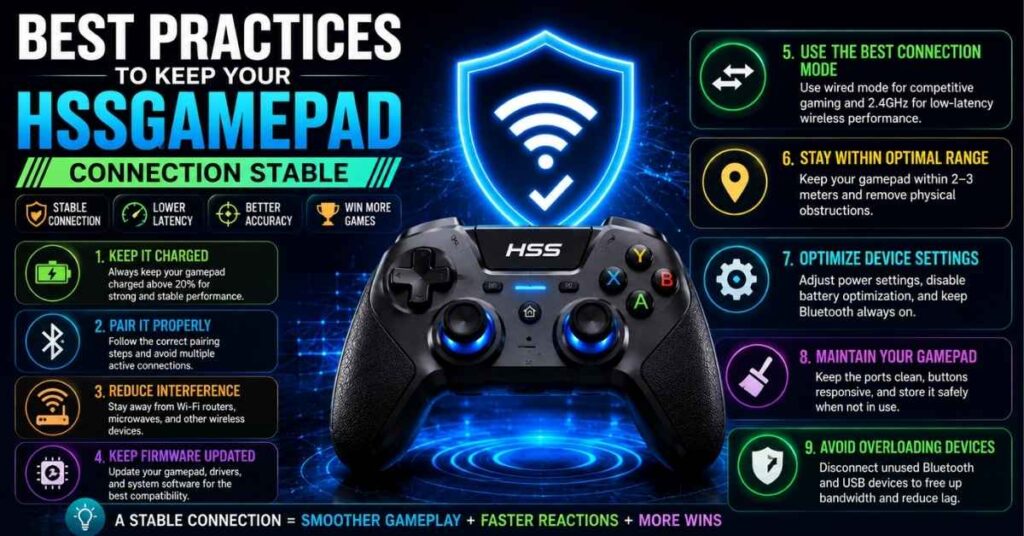
Small habits, repeated consistently, prevent most connectivity headaches before they even start. Building these into your regular routine keeps your gaming setup optimization effortless over time.
Keep Firmware Updated
Check for a new firmware update roughly once a month. Manufacturers patch stability bugs regularly, and skipping updates means living with known, already-solved problems.
Maintain a Strong Wireless Signal
Keep your controller within a reasonable range of its receiver, and avoid placing thick obstacles directly between them whenever you can.
Avoid Bluetooth Congestion
Disconnect devices you aren’t actively using during a session. Fewer active connections means more available bandwidth for the one that actually matters right now.
Store and Charge the Controller Properly
Avoid leaving your controller plugged in overnight constantly, since this can quietly affect long-term battery life. Store it somewhere cool and away from routers or other wireless clutter.
Why Many Gamers Misdiagnose Connectivity Problems
Plenty of players blame the wrong thing entirely. They assume their controller is simply broken. They blame the game’s servers. They chalk up a bad session to a random skill drop that never actually happened.
In reality, most controller connection issues trace back to interference, battery health, or outdated software rather than a defective device. Understanding this distinction saves a lot of wasted time, money, and frustration in the long run.
Real Case Study: Fixing a Laggy HSSGamepad Setup
The Problem
A competitive shooter player reported severe input lag between 150 and 200 milliseconds, along with random disconnects happening mid-match on a near-daily basis.
Diagnosis
Investigation revealed three separate issues stacking together. The controller battery sat at just twelve percent. The router sat directly beside the console. A Bluetooth headset ran actively at the same time, adding even more competing traffic.
Solution Applied
The fix involved switching to a full wired gaming setup, moving the router roughly two meters farther away, and disabling the unused Bluetooth headset during matches. Latency dropped below ten milliseconds almost immediately, and disconnects stopped entirely over the following two weeks.
As one competitive player summarized it: “Your aim only moves as fast as your signal allows. Hesitate on connection, and you’ve already lost the fight before you even pulled the trigger.”
Expert Tips for Achieving the Lowest Input Lag
Serious players treat controller performance the same way they treat their aim training, with consistent attention and small deliberate improvements over time.
Using a dedicated USB port instead of a shared hub reduces unnecessary bandwidth competition. Switching your home Wi-Fi to the 5GHz band, where supported, meaningfully reduces overlap with your controller’s 2.4GHz traffic. Closing unnecessary background applications frees up system resources that would otherwise slow down signal transmission processing. Together, these small controller signal optimization habits compound into a noticeably smoother, more reliable stable gaming experience over time.
Frequently Asked Questions
Why does my HSSGamepad keep disconnecting?
This usually comes down to low battery, excessive distance from the receiver, or nearby wireless congestion competing for the same signal space.
Why does my HSSGamepad lag even though it’s new?
Even brand-new controllers depend entirely on your environment, your firmware version, and your chosen connection method, not just the hardware itself.
Is a wired connection always better than Bluetooth?
For competitive gaming, generally yes. For casual play, Bluetooth connectivity works perfectly well and offers far more freedom of movement.
Can Wi-Fi interfere with my game controller?
Yes. Nearby 2.4GHz Wi-Fi networks can absolutely cause Wi-Fi interference, especially when your router sits close to your gaming setup.
Conclusion
Great gaming performance doesn’t start with expensive new hardware. It starts with a clean, reliable connection between you and your game. Once you understand how connectivity HSSGamepad actually works, you stop blaming random bad luck and start fixing the real causes hiding underneath.
A charged battery, updated firmware, a smart connection choice, and a little connection troubleshooting know-how turn a frustrating, laggy controller into a dependable tool you can actually trust. Master your connection, and you’ll find your hardware was never really the problem in the first place.